
Introduction
In the world of home financing, paperwork tells a story—sometimes a clear one, sometimes a confusing narrative filled with missing pages, misaligned numbers, or overlooked details. Many borrowers assume that once their loan is approved, everything behind the scenes has been handled correctly. But that’s not always the case. A closer review of mortgage documents often reveals discrepancies that could affect financial outcomes in ways most homeowners never expect.
This is where a mortgage securities audit report becomes valuable. It’s not just about reviewing documents—it’s about uncovering inconsistencies, identifying compliance gaps, and ensuring that every part of a mortgage file aligns with legal and financial standards. Whether you’re dealing with loan servicing issues, foreclosure threats, or simply want clarity, such audits can bring transparency to a process that often feels opaque.
On behalf of mortgageauditsonline.com/, this guide explores how mortgage audits work in real-world scenarios. Instead of technical jargon, you’ll find practical insights, lived experiences, and expert-backed explanations. The goal is simple: help homeowners, investors, and even professionals better understand what’s happening behind the paperwork—and why it matters more than ever in today’s lending environment.
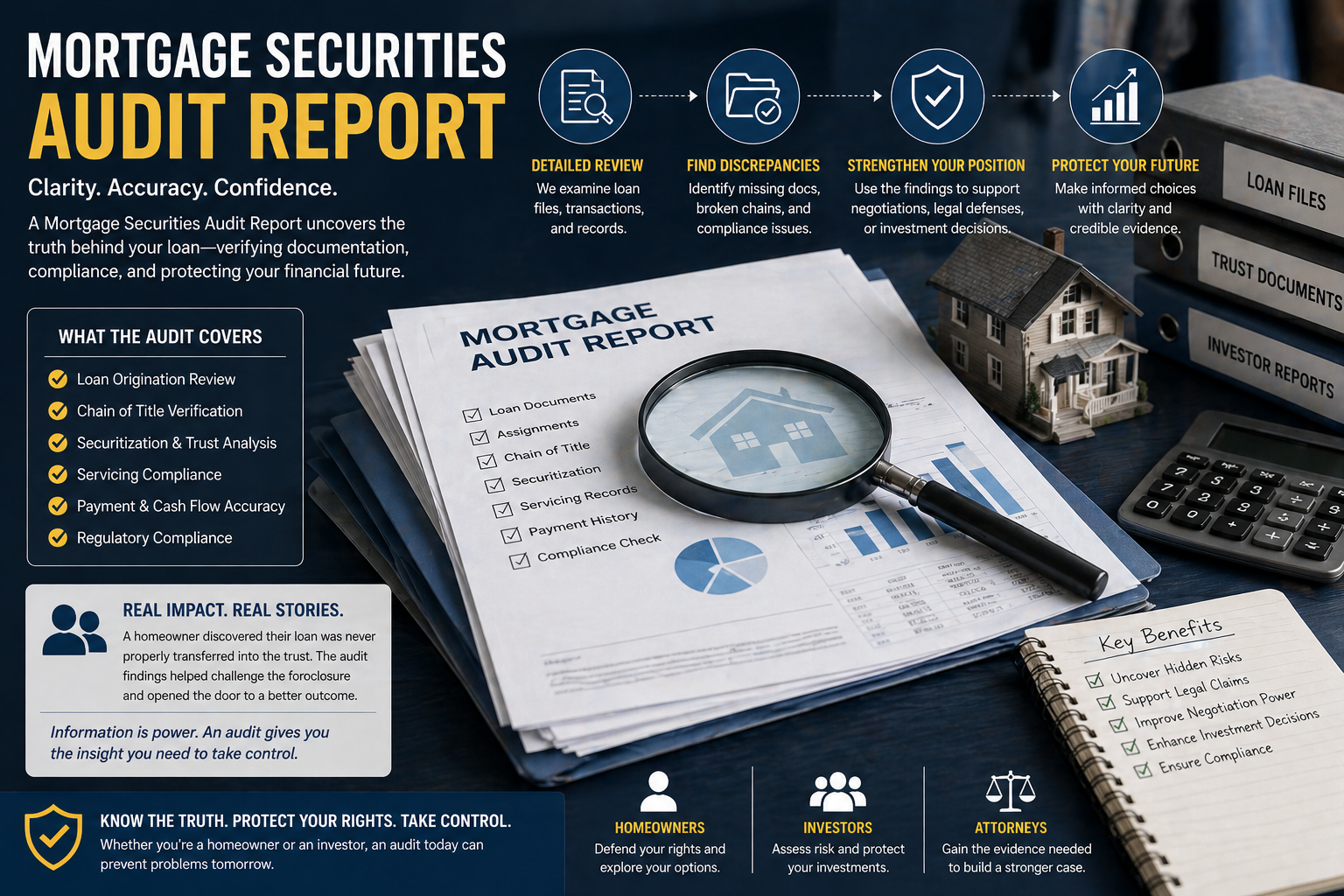
What a Mortgage Securities Audit Actually Examines
A mortgage audit goes beyond surface-level checks. It dives into:
- Loan origination details
- Compliance with federal and state regulations
- Accuracy of interest calculations
- Proper documentation and disclosures
- Securitization trail (where the loan may have been transferred)
These reports often highlight whether lenders followed proper procedures or if any errors slipped through unnoticed.
Common Mistakes Borrowers Overlook
Many homeowners don’t realize how small oversights can lead to larger issues later. Some of the most frequent mistakes include:
- Ignoring loan documents after signing
Once the deal is done, most borrowers never revisit their paperwork. - Assuming lenders are always accurate
Even large institutions can make calculation or compliance errors. - Missing early warning signs
Unexplained charges or inconsistent statements often go unchecked. - Not questioning servicing transfers
Loans frequently change hands, and errors can occur during these transitions.
These mistakes don’t just stay on paper—they can affect payments, credit scores, and even ownership clarity.
A Real Story: When Numbers Didn’t Add Up
A homeowner from Texas noticed that their monthly mortgage payments suddenly increased without a clear explanation. After months of confusion and back-and-forth with the lender, they opted for a mortgage audit.
The audit revealed:
- Incorrect escrow calculations
- Misapplied payments
- Missing documentation during loan transfer
With this information, the homeowner was able to challenge the discrepancies and negotiate corrections. What started as a minor doubt turned into a significant financial recovery.
Practical Tips for Reviewing Your Mortgage
You don’t need to be an expert to start protecting yourself. Here are some grounded steps:
- Keep every document organized
Store both digital and physical copies. - Review statements regularly
Look for patterns, not just individual errors. - Track payment history
Maintain your own record alongside lender statements. - Ask questions early
Don’t wait until problems escalate. - Consider a professional audit
When in doubt, a detailed review can uncover hidden issues.
Expert Advice: When Should You Consider an Audit?
Professionals often recommend a mortgage securities audit in situations like:
- Facing foreclosure or legal disputes
- Noticing unexplained payment changes
- Experiencing frequent loan servicing transfers
- Planning legal action against a lender
- Seeking clarity on loan ownership
Experts emphasize that timing matters. The earlier discrepancies are identified, the easier they are to address.
Testimonials
James R., Florida
“I never thought I’d need an audit, but it revealed errors I couldn’t have spotted myself. It changed everything.”
Linda M., California
“The report gave me clarity and confidence to question my lender. That made all the difference.”
Carlos D., Texas
“What seemed like a small issue turned out to be a major discrepancy. I’m glad I didn’t ignore it.”
Angela P., New York
“The process was detailed but easy to understand. It helped me regain control of my finances.”
Robert K., Illinois
“I wish I had done this earlier. It saved me from bigger problems down the line.”
Understanding Risk Through a Mortgage Securities Report in Today’s Lending Market
Mortgage lending today is far more complex than it appears on the surface. Loans are often bundled, sold, and transferred across institutions, creating layers of financial relationships that most borrowers never see. While this system keeps liquidity flowing in the market, it also introduces opportunities for errors, miscommunication, and compliance gaps.
A mortgage securities report helps decode this complexity. It examines how a loan has been handled, transferred, and documented over time. For borrowers, this isn’t just technical insight—it’s a chance to understand whether their loan has been managed correctly from start to finish.
Presented on behalf of https://www.mortgageauditsonline.com/, this section builds on real-world understanding rather than theory. It focuses on how these reports reveal risks, highlight inconsistencies, and offer clarity in situations where borrowers often feel uncertain.
Why Mortgage Reports Matter More Than Ever
Today’s lending environment involves:
- Multiple servicing transfers
- Securitized loan structures
- Automated payment systems
Each layer adds complexity—and potential for mistakes. A mortgage securities report acts as a checkpoint, ensuring everything aligns properly.
Common Mistakes That Create Long-Term Risks
- Overlooking loan ownership changes
- Ignoring inconsistencies in statements
- Trusting automated calculations blindly
- Failing to verify escrow adjustments
These mistakes often go unnoticed until they become serious financial concerns.
Real Story: A Borrower’s Wake-Up Call
A couple in New Jersey discovered discrepancies in their loan balance after several servicing transfers. Initially dismissed as a minor error, the issue persisted.
A detailed mortgage report revealed:
- Inconsistent balance tracking
- Errors during loan transfer
- Improper fee applications
Armed with this information, they successfully challenged the inaccuracies and corrected their loan records.
Practical Tips to Stay Ahead
- Monitor loan transfers carefully
- Keep communication records with lenders
- Verify annual statements
- Stay informed about your loan structure
Being proactive can prevent long-term complications.
Expert Advice: Building Financial Awareness
Experts stress that borrowers should:
- Treat mortgage documents as active records, not static files
- Seek clarity whenever numbers don’t match expectations
- Use audits as a preventive measure, not just a reactive one
Financial awareness isn’t about distrust—it’s about informed decision-making.
Conclusion
Mortgage documents are more than formalities—they represent long-term financial commitments that can impact stability, security, and peace of mind. A mortgage securities audit report or mortgage securities report offers a window into the details that often go unnoticed. By identifying discrepancies early, borrowers gain the ability to act before issues escalate.
In a system where loans frequently change hands and calculations are automated, relying solely on assumptions can be risky. Taking the time to review, question, and verify ensures that your financial journey remains on solid ground.
FAQ
- What is a mortgage securities audit report?
It’s a detailed review of mortgage documents to identify errors, compliance issues, and inconsistencies. - Who should consider getting one?
Homeowners facing disputes, foreclosure, or unexplained loan changes. - Is it only for legal cases?
No, it can also be used for general financial clarity and verification. - How long does the process take?
It varies depending on the complexity of the loan and documentation. - Can it really make a difference?
Yes, many borrowers have uncovered significant issues that impacted their finances.
Testimonials
Sarah L., Arizona
“The report gave me answers I couldn’t get from my lender.”
Michael T., Georgia
“It helped me understand my loan in a way I never had before.”
David H., Nevada
“I finally felt in control after reviewing the findings.”
Rachel S., Washington
“Clear, detailed, and incredibly helpful.”
Brian C., Ohio
“A smart step for anyone serious about their finances.”
Author’s Bio
Daniel Harper is a U.S.-based financial content writer with over a decade of experience covering mortgage systems, lending practices, and consumer financial protection. His work focuses on simplifying complex financial topics into clear, practical insights that readers can actually use. Daniel collaborates with industry professionals to ensure accuracy and relevance, helping homeowners and investors make informed decisions with confidence.
Over the years, Daniel has worked closely with mortgage auditors, legal consultants, and compliance specialists, gaining first-hand exposure to how loan documentation is reviewed and challenged in real scenarios. This hands-on perspective allows him to bridge the gap between technical audit findings and everyday understanding. Instead of relying on generic explanations, he draws from case-based insights, making his writing grounded and relatable.
Daniel’s articles have supported readers navigating foreclosure concerns, loan servicing errors, and financial uncertainty. His approach is rooted in clarity, careful research, and a commitment to factual accuracy—qualities that align with strong EEAT principles. He believes that financial knowledge should not feel overwhelming or exclusive, but accessible to anyone willing to understand their situation better.
When he’s not writing, Daniel spends time researching evolving lending regulations and tracking changes in mortgage servicing practices across the United States. His ongoing work with platforms like https://www.mortgageauditsonline.com/ reflects his dedication to helping borrowers stay informed, prepared, and confident in managing one of the most important financial commitments of their lives.