
A Story That Starts Quietly
Ramesh never thought a stack of papers could change his life. Sitting at his dining table in a modest home, he stared at his mortgage statements—confused, frustrated, and slightly uneasy. Everything looked official, stamped, and perfectly in order. Yet something didn’t feel right.
Months earlier, he had taken a home loan with confidence. The terms seemed clear, the process smooth. But over time, small inconsistencies began to surface—unexpected charges, unclear adjustments, and vague explanations from the lender.
One evening, a friend mentioned something unfamiliar: a securitization audit. That simple conversation would soon uncover what Ramesh couldn’t see on his own.
A Question Worth Asking
What if your mortgage documents aren’t as accurate as they seem?
Most homeowners trust lenders blindly, assuming compliance and fairness are guaranteed. But what if errors, misrepresentations, or compliance gaps exist deep within the loan structure?
The Real Problem Most Borrowers Overlook
The truth is uncomfortable—mortgage-related errors are more common than people think.
These are not always deliberate, but they can still cost borrowers significantly. Issues may include:
- Incorrect loan securitization processes
- Missing or flawed documentation
- Violations of lending regulations
- Improper assignment of mortgage rights
The problem? These issues remain buried under technical language and complex paperwork, making them nearly invisible to the average borrower.
A Real Example That Speaks Volumes
Take the case of Anita, a homeowner who faced foreclosure despite making regular payments. Her lender insisted everything was valid.
However, when she opted for a detailed securitization audit report, several discrepancies surfaced:
- The chain of title had gaps
- Key documents were improperly transferred
- Certain compliance standards were not followed
These findings gave her legal leverage, ultimately helping her delay foreclosure and negotiate better terms.
Her case wasn’t unique—it was simply uncovered.
Understanding the Mortgage Securities Audit Report
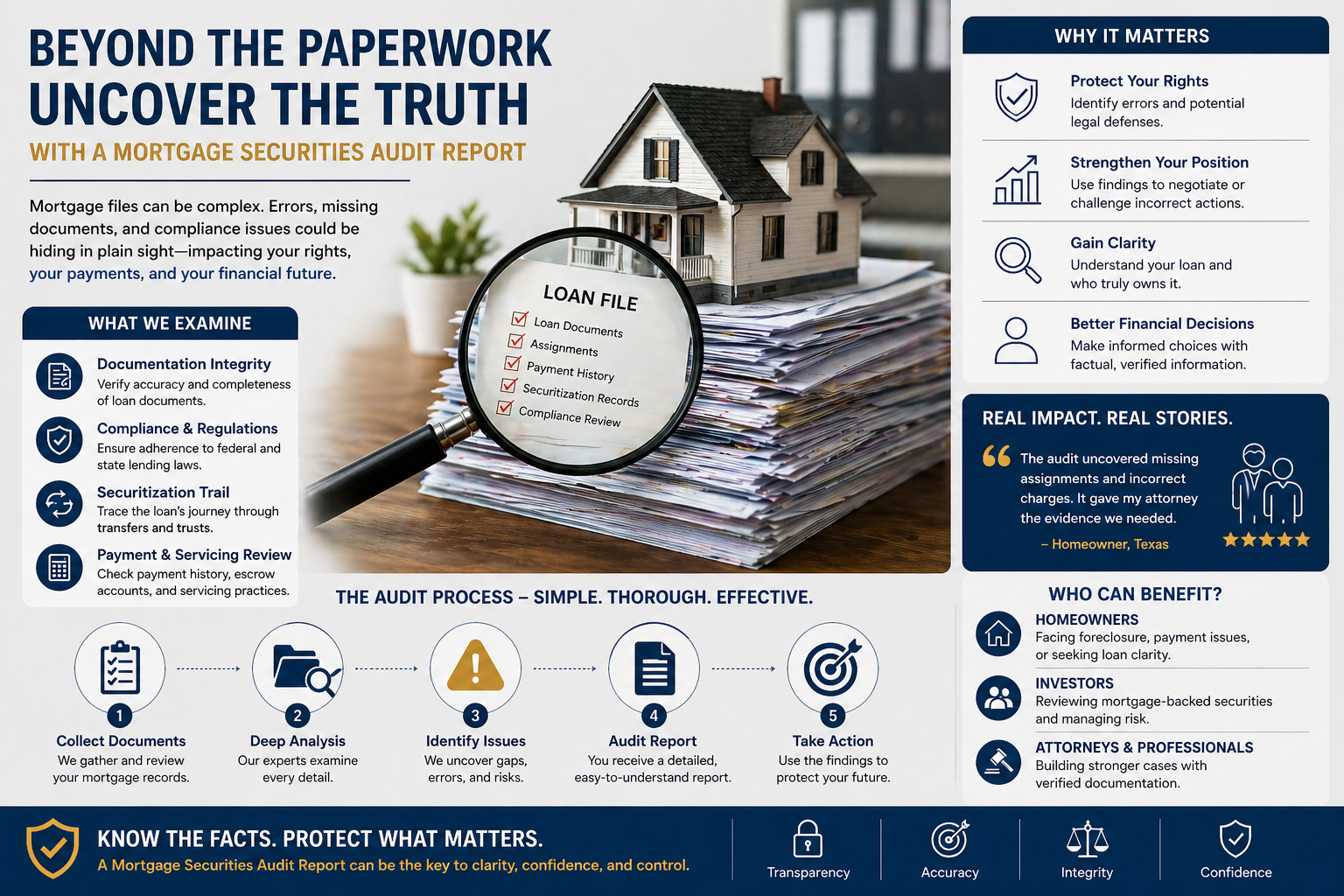
A securitization audit is not just another document—it is a detailed forensic review of your mortgage loan. It examines whether your loan was properly originated, transferred, and managed according to legal and financial standards.
At its core, this audit dives into the securitization process. When lenders bundle mortgages into securities and sell them to investors, strict rules must be followed. Any deviation can create legal vulnerabilities.
This report evaluates:
- The legitimacy of loan ownership transfers
- Compliance with federal and state laws
- Accuracy of recorded documents
- Potential violations in securitization
In simple terms, it answers a critical question: Is your mortgage legally and structurally sound?
Why This Report Matters More Than Ever
In today’s financial environment, loans are rarely held by a single lender. They are bought, sold, and repackaged multiple times.
Each transfer introduces the possibility of error.
A securitization audit acts as a safeguard. It identifies issues that could:
- Impact foreclosure proceedings
- Provide negotiation power
- Reveal overcharges or improper fees
- Strengthen legal defense strategies
For homeowners facing uncertainty, this report offers clarity—and sometimes, a second chance.
Common Mistakes Borrowers Make
Many homeowners unknowingly weaken their position by making avoidable mistakes:
Ignoring document discrepancies
Small errors are often dismissed, but they can indicate deeper issues.
Trusting verbal assurances
Lenders may provide explanations, but without documentation, they hold little value.
Delaying professional review
Waiting until foreclosure begins limits available options.
Overlooking securitization details
Most borrowers don’t realize their loan may have been transferred multiple times.
These mistakes are not due to negligence—they stem from lack of awareness.
Expert Insight from Mortgage Audit Professionals
Professionals working in mortgage audits emphasize one thing consistently: documentation tells the real story.
According to industry experts, a properly conducted the audit report can uncover patterns that are otherwise invisible. These include systemic compliance failures and improper handling of loan ownership.
Experts also highlight that the value of such reports lies not only in identifying problems but in presenting them in a legally usable format.
In many cases, these reports become critical tools in legal proceedings, negotiations, and financial restructuring.
Practical Tips to Protect Yourself
If you’re a homeowner or borrower, taking proactive steps can make a significant difference:
Review your mortgage documents carefully
Look for inconsistencies in names, dates, and amounts.
Request a complete loan history
Understanding how your loan has been handled over time is crucial.
Consider a professional audit early
Don’t wait for financial distress to explore your options.
Stay informed about your rights
Knowledge is your strongest defense in complex financial matters.
Keep records organized
Well-maintained documentation strengthens your position in disputes.
These steps are simple, but their impact can be substantial.
The Emotional Side of Financial Uncertainty
Behind every mortgage is a home—and behind every home is a family.
Financial confusion doesn’t just affect numbers; it affects peace of mind. The stress of not knowing whether your loan is accurate or fair can weigh heavily over time.
For many, discovering issues through a securitization audit is both shocking and empowering. It replaces uncertainty with understanding, and fear with informed action.
A Closing Thought That Stays With You
Ramesh’s story didn’t end with confusion. After reviewing his mortgage through a detailed audit, he found discrepancies that gave him the confidence to challenge his lender.
He didn’t just protect his finances—he protected his home.
The question is no longer whether errors exist in mortgage systems. The real question is whether you are aware of them in your own loan.
Because sometimes, what you don’t see can cost you the most.
uncover what Ramesh couldn’t see on his own.
A Question Worth Asking
What if your mortgage documents aren’t as accurate as they seem?
Most homeowners trust lenders blindly, assuming compliance and fairness are guaranteed. But what if errors, misrepresentations, or compliance gaps exist deep within the loan structure?
The Real Problem Most Borrowers Overlook
The truth is uncomfortable—mortgage-related errors are more common than people think.
These are not always deliberate, but they can still cost borrowers significantly. Issues may include:
- Incorrect loan securitization processes
- Missing or flawed documentation
- Violations of lending regulations
- Improper assignment of mortgage rights
The problem? These issues remain buried under technical language and complex paperwork, making them nearly invisible to the average borrower.
A Real Example That Speaks Volumes
Take the case of Anita, a homeowner who faced foreclosure despite making regular payments. Her lender insisted everything was valid.
However, when she opted for a detailed this type of audit, several discrepancies surfaced:
- The chain of title had gaps
- Key documents were improperly transferred
- Certain compliance standards were not followed
These findings gave her legal leverage, ultimately helping her delay foreclosure and negotiate better terms.
Her case wasn’t unique—it was simply uncovered.
Understanding the Mortgage Securities Audit Report
A securitization audit is not just another document—it is a detailed forensic review of your mortgage loan. It examines whether your loan was properly originated, transferred, and managed according to legal and financial standards.
At its core, this audit dives into the securitization process. When lenders bundle mortgages into securities and sell them to investors, strict rules must be followed. Any deviation can create legal vulnerabilities.
This report evaluates:
- The legitimacy of loan ownership transfers
- Compliance with federal and state laws
- Accuracy of recorded documents
- Potential violations in securitization
In simple terms, it answers a critical question: Is your mortgage legally and structurally sound?
Why This Report Matters More Than Ever
In today’s financial environment, loans are rarely held by a single lender. They are bought, sold, and repackaged multiple times.
Each transfer introduces the possibility of error.
A mortgage securities audit report acts as a safeguard. It identifies issues that could:
- Impact foreclosure proceedings
- Provide negotiation power
- Reveal overcharges or improper fees
- Strengthen legal defense strategies
For homeowners facing uncertainty, this report offers clarity—and sometimes, a second chance.
Common Mistakes Borrowers Make
Many homeowners unknowingly weaken their position by making avoidable mistakes:
Ignoring document discrepancies
Small errors are often dismissed, but they can indicate deeper issues.
Trusting verbal assurances
Lenders may provide explanations, but without documentation, they hold little value.
Delaying professional review
Waiting until foreclosure begins limits available options.
Overlooking securitization details
Most borrowers don’t realize their loan may have been transferred multiple times.
These mistakes are not due to negligence—they stem from lack of awareness.
Expert Insight from Mortgage Audit Professionals
Professionals working in mortgage audits emphasize one thing consistently: documentation tells the real story.
According to industry experts, a properly conducted mortgage securities audit report can uncover patterns that are otherwise invisible. These include systemic compliance failures and improper handling of loan ownership.
Experts also highlight that the value of such reports lies not only in identifying problems but in presenting them in a legally usable format.
In many cases, these reports become critical tools in legal proceedings, negotiations, and financial restructuring.
Practical Tips to Protect Yourself
If you’re a homeowner or borrower, taking proactive steps can make a significant difference:
Review your mortgage documents carefully
Look for inconsistencies in names, dates, and amounts.
Request a complete loan history
Understanding how your loan has been handled over time is crucial.
Consider a professional audit early
Don’t wait for financial distress to explore your options.
Stay informed about your rights
Knowledge is your strongest defense in complex financial matters.
Keep records organized
Well-maintained documentation strengthens your position in disputes.
These steps are simple, but their impact can be substantial.
A Moment Before You Decide
Before you move forward with blind trust or delayed action, pause for a moment and think about what your mortgage truly represents. It’s not just a financial agreement—it’s a long-term commitment tied to your stability, your family’s comfort, and your future plans.
Many borrowers assume everything is functioning correctly simply because payments are being made on time. But as countless cases have shown, underlying issues don’t always surface immediately. Taking a proactive step today—whether it’s reviewing documents or seeking a professional audit—can prevent far more serious complications later. Sometimes, the difference between financial stress and financial control comes down to one informed decision made at the right time.
Conclusion
A mortgage securities audit report is more than a technical analysis—it is a powerful tool for transparency and protection. In a system where loans move through complex financial channels, borrowers often remain unaware of underlying issues.
By uncovering discrepancies, compliance gaps, and structural flaws, this report equips homeowners with knowledge and leverage. It shifts the balance from uncertainty to control.
For anyone dealing with a mortgage—whether facing challenges or simply seeking clarity—taking a closer look is not just wise, it is necessary.
Understanding your loan is not optional anymore. It is the first step toward securing your financial future and safeguarding what matters most—your home.