
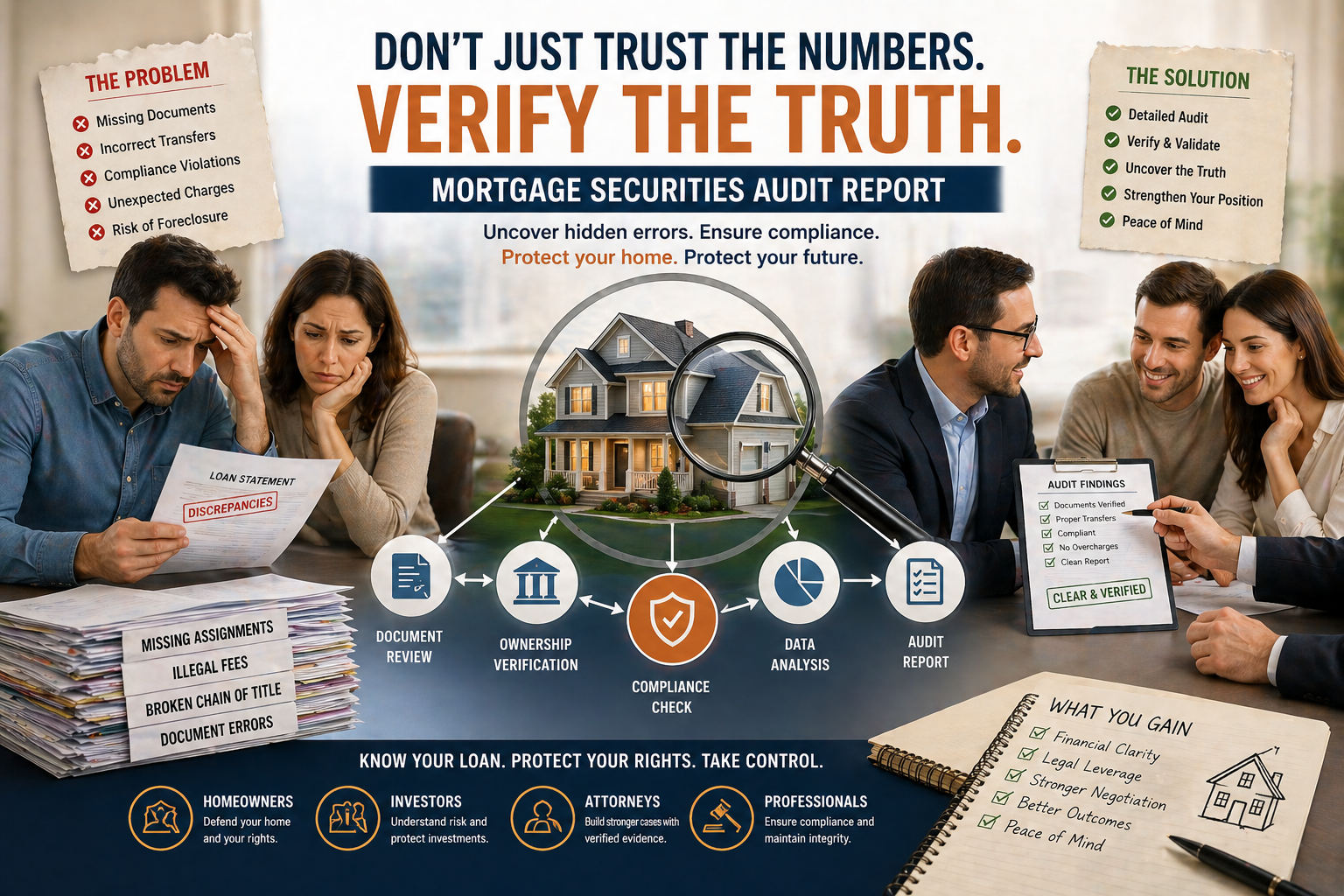
A Quiet Mistake That Changed Everything
Ramesh thought his loan documents were just routine paperwork. Like many homeowners, he signed where he was told and trusted the system to work in his favor. Months later, he began noticing irregular charges and confusing statements tied to his mortgage-backed investment. At first, it seemed minor. But over time, those inconsistencies turned into a financial burden he couldn’t explain.
What went wrong?
The answer came from something most borrowers never think about — a detailed review known as a securitization audit report.
If you’ve never heard of it, you’re not alone. Yet, for homeowners, investors, and even legal professionals, this document can reveal hidden errors, compliance failures, and even violations that could significantly impact financial outcomes.
So here’s the real question:
Are you absolutely sure your mortgage documents are accurate, lawful, and properly handled?
Let’s explore what this report really means — not in technical jargon, but in practical, real-world terms.
What Is a securitization audit?
A the audit report is a detailed examination of loan documents, securitization processes, and compliance with lending laws. It looks beyond surface-level paperwork and investigates whether the mortgage was properly originated, transferred, and managed.
Unlike a basic review, this audit digs deep into:
- Loan origination accuracy
- Truth in Lending disclosures
- Chain of title and ownership transfers
- Securitization practices
- Regulatory compliance
In simple words, it answers one critical question:
Was your mortgage handled correctly from start to finish?
Why This Report Matters More Than You Think
Most borrowers assume lenders follow strict rules. In reality, errors happen more often than expected — sometimes due to negligence, sometimes due to systemic issues in the securitization process.
A properly prepared this type of audit can uncover:
- Missing or flawed documentation
- Illegal fee structures
- Misrepresentation in loan terms
- Improper transfers in mortgage-backed securities
- Violations of federal lending laws
For homeowners facing foreclosure or financial disputes, these findings can make a substantial difference.
The Hidden Complexity of Mortgage Securitization
When mortgages are bundled and sold as securities, they pass through multiple entities — lenders, trustees, servicers, and investors. Each transfer must follow strict legal guidelines.
If even one step is mishandled, the integrity of the loan may be compromised.
That’s where a securitization audit becomes essential. It tracks every movement and checks whether proper procedures were followed.
Common Mistakes Borrowers Overlook
Many borrowers don’t realize how small oversights can lead to major consequences. Here are some frequent issues uncovered during audits:
Ignoring Loan Document Details
Most people never revisit their original loan agreement. Errors often hide in plain sight.
Assuming Compliance Without Verification
Just because a loan was approved doesn’t mean it was compliant with all regulations.
Overlooking Securitization Errors
Improper transfers in mortgage-backed securities can weaken the legal standing of a loan.
Delaying Action
Waiting too long to review documents can limit legal and financial options.
A Real Story That Shows Why It Matters
A homeowner in California was facing foreclosure and had nearly given up hope. The lender claimed full legal ownership and presented standard documentation.
However, after obtaining a securitization audit through Mortgage Audits Online, inconsistencies were found in the chain of title. The loan had been transferred multiple times without proper documentation.
This discovery changed the entire case. The homeowner was able to challenge the foreclosure and negotiate a more favorable outcome.
Stories like this are not rare — they simply remain unheard.
How Mortgage Audits Online Approaches the Process
When working with professionals like those at Mortgage Audits Online, the focus is not just on identifying errors but presenting them in a clear, structured way.
Their process includes:
- Reviewing all loan-related documents
- Analyzing securitization patterns
- Identifying compliance violations
- Preparing a legally structured report
This approach ensures the audit is not only thorough but also usable in legal or financial discussions.
Practical Tips Before Requesting an Audit
If you’re considering a securitization audit, preparation can make a significant difference.
Gather All Documentation
Include loan agreements, payment history, notices, and correspondence.
Understand Your Objective
Are you looking to challenge foreclosure, verify compliance, or gain clarity? Your goal will shape the audit.
Choose Experienced Professionals
Not all audits are equal. Expertise matters when interpreting complex financial and legal data.
Act Early
The sooner you review your mortgage, the more options you may have.
Expert Advice from Industry Professionals
Experts in mortgage auditing emphasize one key point:
Transparency in lending is not guaranteed — it must be verified.
According to professionals at Mortgage Audits Online:
- Even minor discrepancies can have legal implications
- Documentation errors are more common than expected
- A structured audit report strengthens your position in disputes
They also stress the importance of clarity. A good mortgage securities audit report doesn’t just identify issues — it explains them in a way that borrowers, attorneys, and courts can understand.
How This Report Supports Legal and Financial Decisions
A mortgage securities audit report can serve multiple purposes:
- Supporting foreclosure defense strategies
- Assisting attorneys in building cases
- Helping borrowers negotiate loan modifications
- Providing clarity for investors
It turns confusion into documented insight — something far more powerful than assumptions.
Customer Testimonials
- Anil S. – Mumbai
“I had no idea there were issues in my loan documents until I got the audit done. It gave me confidence to question my lender.” - Rebecca M. – Texas
“The report was detailed yet easy to understand. It helped my attorney build a strong case.” - David K. – Florida
“I was skeptical at first, but the findings were eye-opening. It changed how I approached my situation.” - Priya D. – Bangalore
“Professional, accurate, and incredibly helpful. I wish I had done this earlier.” - Michael R. – New York
“The clarity this report provided was worth every penny. It revealed things I would never have noticed.”
Frequently Asked Questions
What makes a mortgage securities audit report different from a standard audit?
It focuses specifically on securitization, compliance, and legal validity rather than just financial accuracy.
Can this report stop foreclosure?
It doesn’t stop foreclosure directly, but it can provide evidence that may support legal action or negotiation.
How long does the audit process take?
Typically, it depends on document availability, but most reports are completed within a few days to a couple of weeks.
Is this only for homeowners in distress?
No. Investors and borrowers seeking clarity also benefit from these audits.
Do I need a lawyer to use the report?
Not necessarily, but legal professionals can better utilize the findings in disputes or court proceedings.
A Final Thought Before You Decide
Before you move forward—whether it’s making another payment, negotiating with your lender, or responding to legal notices—pause for a moment. Many borrowers act based on assumptions, not verified facts. A mortgage may look valid on the surface, but underlying discrepancies can quietly shape outcomes in ways you might not expect. Taking the time to review and understand your loan through a mortgage securities audit report is not about creating conflict; it’s about ensuring that every detail stands up to scrutiny. When you base decisions on verified information rather than guesswork, you shift from reacting to problems to managing them with confidence.
Conclusion: Clarity Brings Control
A mortgage is one of the most significant financial commitments a person makes. Yet, many people rely entirely on trust without verification. That’s where problems begin.
A mortgage securities audit report offers something rare in complex financial systems — clarity. It uncovers what’s hidden, explains what’s confusing, and gives borrowers the information they need to make informed decisions.
Whether you’re facing financial uncertainty or simply want peace of mind, reviewing your mortgage is not a risk — it’s a responsibility.
Because in the end, understanding your loan isn’t just about numbers.
It’s about protecting your future.
What many borrowers fail to realize is that even a single overlooked detail can shape long-term financial outcomes. Small discrepancies today can turn into serious complications tomorrow, especially when legal or foreclosure situations arise. By taking a proactive approach and reviewing your loan through a detailed audit, you gain more than information—you gain leverage. You become aware of your rights, your options, and your next move. In a system where complexity often works against the borrower, clarity becomes your strongest advantage.
Author’s Bio
Arjun Mehta is a financial research writer and mortgage compliance analyst with over a decade of experience in loan auditing and securitization review. He has worked closely with legal teams, financial consultants, and audit firms to simplify complex mortgage structures for everyday borrowers.
Through his work with Mortgage Audits Online, Arjun focuses on bringing transparency to the lending process, helping individuals uncover critical details often buried in documentation. His writing combines real-world insights with practical guidance, making financial topics accessible without losing depth or accuracy.
When he’s not analyzing mortgage reports, Arjun writes extensively on financial accountability, borrower rights, and evolving lending practices.